
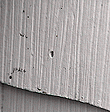
You found out that your house is covered in asbestos siding or roofing shingles and they are falling apart. Now... what do you do about it? Will it cost a fortune? This page will help you understand asbestos shingles, their health effects, and what to do about it.
Asbestos siding was used extensively in buildings and homes from the 1930s until the 1970s, when it's use was banned. Originally, asbestos siding was used because of the fire resistant properties of asbestos. Because asbestos in a mineral and fibrous, adding asbestos to siding materials also increases strength and durability, while providing some insulation and fireproofing to the structure.
Even if asbestos shingles are on your home, if they are in good condition and left undisturbed, they are usually NOT a serious problem. The mere presence of asbestos in a home or a building is not hazardous. The danger is that asbestos materials may become damaged over time and become airborne. Damaged asbestos may release asbestos fibers and become a health hazard.
For a broad and detailed summary of asbestos in and around the home, see our Asbestos in the Home page.
Asbestos is regulated under a variety of laws and agencies; here's a brief summary. See our asbestos regulations page for more information . The Environmental Protection Agency regulations that govern asbestos removal and disposal are the National Emission Standards for Hazardous Air Pollutants. OSHA has regs that apply to school systems. TSCA (under EPA) has regulations governing disposal.
Except for disposal, these rules, however, do not apply to houses of four families or less. An owner of a single-family residence can remove and dispose of asbestos cement shingles without being subject to federal restrictions that apply to contractors. There will most likely be state and local ordinances governing asbestos shingles and their removal. These may prohibit removal and disposal by anyone other than a licensed and certified asbestos contractor. Your state's regs may apply to homeowners - check - if they do then:
State permits are often required of contractors for the removal of asbestos containing asphalt/ bituminous roofing products and asbestos cement shingles/panels under the following conditions:
NOTE: Friable ACM means the material has been crumbled, pulverized, reduced to powder, or has otherwise deteriorated so that the asbestos is no longer likely to be bound within its matrix.
Permits must usually be obtained ten (10)working days prior to staring the removal of regulated asbestos containing roofing material. Within 45 calendar days from the completion date stated on the permit, the owner or his representative must submit a completed Waste Shipment record to the state or county agency.
Before removing any asbestos-containing material from your house, you should check with your local government authority; usually the county health department will know.

THE BEST THING TO DO WITH ASBESTOS MATERIAL IN GOOD CONDITION IS TO LEAVE IT ALONE! Disturbing it may create a health hazard where none existed before. Read this page before you have any asbestos material inspected, removed, or repaired.
Asbestos cement roofing, shingles and siding products are not likely to release asbestos fibers unless sawed, dilled, or cut.
If the asbestos material is in good shape and will not be disturbed, do nothing! If it is a problem, there are two types of corrections: repair and removal .
REPAIR usually involves either sealing or covering asbestos material.
With any type of repair, the asbestos remains in place. Repair is usually cheaper than removal, but it may make later removal of asbestos, if necessary, more difficult and costly. Repairs can either be major or minor.
Major repairs must be done only by a professional trained in methods for safely handling asbestos. Some people hire an asbestos abatement firm just to remove and dispose of the siding on the back of the house before starting work on the addition.
Minor repairs should also be done by professionals since there is always a risk of exposure to fibers when asbestos is disturbed.
Doing minor repairs yourself is not recommended since improper handling of asbestos materials can create a hazard where none existed. If you nevertheless choose to do minor repairs, you should have as much information as possible on the handling of asbestos before doing anything. Contact your state or local health department or regional EPA office for information about asbestos training programs in your area. Your local school district may also have information about asbestos professionals and training programs for school buildings. Even if you have completed a training program, do not try anything more than minor repairs. Before undertaking minor repairs, carefully examine the area around the damage to make sure it is stable. As a general matter, any damaged area which is bigger than the size of your hand is not a minor repair.
If a renovation project requires fairly extensive work, it may be wise to call in a contractor. In this case, check into his experience in handling asbestos-containing materials, and discuss the preventive measures he plans to take.
Before undertaking minor repairs, be sure to follow all the precautions described earlier for sampling asbestos material. Always wet the asbestos material using a fine mist of water containing a few drops of detergent. Commercial products designed to fill holes and seal damaged areas are available. Small areas of material such as pipe insulation can be covered by wrapping a special fabric, such as rewettable glass cloth, around it. These products are available from stores (listed in the telephone directory under Safety Equipment and Clothing") which specialize in asbestos materials and safety items.
And certainly if you are drilling, hammering or breaking any tiles, use a respirator - see below to order a good reusable one:
REMOVAL is usually the most expensive method and, unless required by state or local regulations, should be the last option considered in most situations. This is because removal poses the greatest risk of fiber release. However, removal may be required when remodeling or making major changes to your home that will disturb asbestos material. Also, removal may be called for if asbestos material is damaged extensively and cannot be otherwise repaired. Removal is complex and must be done only by a contractor with special training. Improper removal may actually increase the health risks to you and your family.
But be forewarned: asbestos-cement shingles can cost a bundle to remove and properly dispose of.
Though private homes are usually not covered by the asbestos regulations that apply to schools and public buildings, professionals should still use procedures described during federal or state-approved training. It should be noted that any company that you hire to work on asbestos in your home WILL be subject to asbestos disposal regulations AND to the standards for worker protection - and you should want this because if they are sloppy OR don't protect their own workers, how much care do you think they will have for you and your family's health?
Homeowners should be alert to the chance of misleading claims by asbestos consultants and contractors. There have been reports of firms incorrectly claiming that asbestos materials in homes must be replaced. In other cases, firms have encouraged unnecessary removals or performed them improperly. Unnecessary removals are a waste of money. Improper removals may actually increase the health risks to you and your family. To guard against this, know what services are available and what procedures and precautions are needed to do the job properly. And we know it won't be cheap: a typical rate for an asbestos abatement company is around $2.50/sq.ft. (2001 prices)
In addition to general asbestos contractors, you may select a roofing, flooring, or plumbing contractor trained to handle asbestos when it is necessary to remove and replace roofing, flooring, siding, or asbestos-cement pipe that is part of a water system. Normally, roofing and flooring contractors are exempt from state and local licensing requirements because they do not perform any other asbestos-correction work. BUT if they do remove asbestos they WILL be subject to the requirements! Call 1-800-USA-ROOF for names of qualified roofing contractors in your area. (Illinois residents call 708-318-6722.) For information on asbestos in floors, read "Recommended Work Procedures for Resilient Floor Covers." You can write for a copy from the Resilient Floor Covering Institute, 966 Hungerford Drive, Suite 12-B, Rockville, MD 20850. Enclose a stamped, business-size, self-addressed envelope.
|
Caution!
Do not dust, sweep, or vacuum debris that may contain asbestos. These steps will disturb tiny asbestos fibers and may release them into the air. Remove dust by wet mopping or with a special HEPA vacuum cleaner used by trained asbestos contractors. |
For more information on asbestos in other consumer products, call the CPSC Hotline or write to the U.S. Consumer Product Safety Commission, Washington, DC 20207. The CPSC Hotline has information on certain appliances and products, such as the brands and models of hair dryers that contain asbestos. Call CPSC at 1-800-638-CPSC. A teletypewriter (TTY) for the hearing impaired is available at 1-800-638-8270. The Maryland TTY number is 1-800-492-8104.
To find out whether your state has a training and certification program for asbestos removal contractors, and for information on EPA's asbestos programs, call the EPA at 202-554-1404.
For more information on asbestos identification and control activities, contact the Asbestos Coordinator in the EPA Regional Office for your region, or your state or local health department.
1. Are there any federal grants to help me with the cost of replacing asbestos siding on my home?
None at this time. The federal aid programs were aimed at public schools.
2. What paperwork must be submitted prior to removing regulate asbestos containing roofing materials?
An Asbestos Permit Application and Notification for Demolition/Renovation (DEHNR 3768) must be submitted to the NCHHCB ten (10)working days prior to staring the removal of regulated asbestos containing roofing material.
Also, within 45 calendar days from the completion date stated on the permit, the owner or his representative must submit a completed Waste Shipment record (DEHNR 3787) to the NCHHCB.
3. How do you calculate permit fees for the removal of regulated asbestos containing built-up roofing material?
The amount of regulated asbestos containing built-up roofing material created during removal is calculated based upon information found in the NESHAP Interpretative Rule Governing roof removal Operations (40 CFR 61, Subpart M, Appendix A).This rule states that 160 square feet of regulated asbestos containing material is created for each 5580 square feet of built-up roofing material cut by a rotating blade cutter.
Fees for the removal of regulated asbestos containing roofing materials are 1% of the contract price or $.10 per square or linear foot, whichever is greater. The fee is not based on the put-back of new materials. To calculate the square foot fees, divide the total square footage of the roof by 5580. Multiply this number by 160-The resulting number is then multiplied by $.10 to get the total permit fee. See example below:
Built-up Roof area = 22,320 square feet
22,320/5580 = 4
4x 160 x $.10-$64.00
4. How do you calculate permit fees for the removal of regulated asbestos cement shingles/panels?
The fees are based upon the tear-off and disposal of regulated asbestos containing cement shingles/panels but not the put-back of new materials. The procedure for calculating the square footage fees for regulated asbestos containing cement shingles/panels is 1% of the contract price or $.10 per square foot, whichever is greater. See example below:
Asbestos cement shingle/panels roof area = 1000 square feet
1000 x $.10 = $100
5. Are permit fees always required for removing asbestos built-up roofing materials or asbestos cement shingles/panels?
No. Permit fees are not required if you are removing less than the thresh old amounts of regulated asbestos containing materials listed in question #l. Permit fees are not required for the removal of asbestos containing built-up roofing material when manual techniques (axes, knives, etc.) are used, Also, permit fees are not required when asbestos cement shingles/panels are removed intact.
6. Who must be accredited to remove regular asbestos containing built-up roofing materials or regulated asbestos cement singles/panels?
The asbestos roofing supervisor and anyone handling the regulated asbestos containing roofing material. This would typically include anyone operating a rotating blade cutter of HEPA vacuum, wetting the regulated material, bagging the regulated waste, or placing the regulated waste into a container for transportation to the disposal site.
7. When would an individual not have to be accredited by the NC HHCB?
When removing less than the threshold amounts stated in question #l. When using manual techniques (i.e. axes, knives, etc.) for the removal of asbestos built-up roofing material. When removing asbestos cement sin gles/panels intact or when the material does not become regulated.
Please note that the OSHA Asbestos Construction Standard, 29 CFR 1926.1 101, requires every individual involved in the removal of asbestos containing roofing products to have asbestos training. For additional information on OSHA requirements, contact the North Carolina Department of Labor at 1-800-L^BOR-NC.
8. Does the accredited asbestos roofing supervisor have to stay on site during the removal of regulated asbestos containing roofing material?
An accredited asbestos roofing supervisor shall be on site at all times when the removal of regulated asbestos containing roofing material is being con ducted.
9. Does the accredited asbestos roofing supervisor have to stay on site during the removal of nonregulated asbestos containing roofing material?
No. However, the OSHA Asbestos Construction Standard, 29 CFR 1926.1 101, requires a competent person, who has been asbestos trained, to make on-site inspections at "intervals sufficient to assess" whether conditions have changed and at any reasonable time an employee requests such as inspection. For additional information on OSHA requirements, contact the North Carolina Department of Labor at I -800-LABOR-NC.
10. Can the accredited asbestos roofing supervisor make a decision to remove regulated asbestos containing roofing material without wetting the material if it is not feasible or it will create a safety haz ard?
The National Emission Standard for Hazardous Air Pollutants (NESHAP) for asbestos requires prior written approval for removal of regulated asbestos containing material without wetting. The person requesting approval for dry removal must submit a written application along with all pertinent data justifying the need for dry removal to the Health Hazards Control Branch. However, in the four (4) counties with Local Air Pollution Control Programs (Forsyth, Mecklenburg, Buncombe, Haywood), a written application for dry removal should be submitted to the local asbestos coordinator.
For additional information on OSHA requirements, contact the North Carolina Department of Labor at I-800-LABOR-NC.
11. Can an accredited asbestos roofing worker perform asbestos abatement work?
No, an accredited asbestos roofing worker is limited to Class II activities involving the removal of asbestos containing roofing products.
12. Can an accredited roofing supervisor perform asbestos abatement work?
No, an accredited asbestos roofing supervisor is limited to Class II activities involving the removal of asbestos containing roofing products.
13. Can an accredited asbestos roofing supervisor perform an asbestos roof inspection, including the collection of bulk samples?
Yes, but the inspection is limited only to roofing products and shall not include other suspect materials such as pipe insulation, HVAC insulation, cooling towers, etc.
Please note that the tear-off and replacement of roofing materials may dislodge spray-applied asbestos containing fire-proofing from the buildings roof deck and beams. It is strongly recommended that an asbestos survey be con ducted below the roof deck by an accredited asbestos inspector prior to beginning roofing activities. The accredited asbestos inspector could also sample other suspect materials which may be located on the roof.
14. Are there other references that discuss roofing issues and regulatory requirements?
Yes, a summary document entitled, "The Guidance On The Regulatory Requirements For Conducting Asbestos Containing Roofing Work in North Corolina.'' This document is available from the NC HHCB upon request.
Ways to save money AND help the environment:
Save water AND money with this showerhead adapter, it lets the water flow until the water is hot, then shuts off water flow until you restart it, ShowerStart TSV Hot Water Standby Adapter

Protect your health with these:
Mattress Dust mite-Bedbug protector, 100% Waterproof, Hypoallergenic, Zippered
Handheld Allergen Vacuum Cleaner with UV Sanitizing for Allergies and Pet, Kills Mite, Virus, Molds, True HEPA with Powerful Suction removes Hair, Dander, Pollen, Dust ,
,
Immune Support Supplement with Quercetin, Vitamin C, Zinc, Vitamin D3
GermGuardian Air Purifier with UV-C Light and HEPA 13 Filter, R emoves 99.97% of Pollutants
HEPA Air Purifier, HEPA Air Cleaner with Washable Pre-Filter, AQI Display, ECO Mode, Sleep Mode, Pet Mode for Pets, Dust, Pollen, Removes 99.97% of Particles, Smoke, Mold, Pet Dander, Dust, Odors
Interesting Reads:
THE PREPPER'S CANNING & PRESERVING BIBLE: [13 in 1] Your Path to Food Self-Sufficiency. Canning, Dehydrating, Fermenting, Pickling & More, Plus The Food Preservation Calendar for a Sustainable Pantry
The Backyard Homestead: Produce all the food you need on just a quarter acre! P aperback
The Citizens' Guide to Geologic Hazards: A Guide to Understanding Geologic Hazards Including Asbestos, Radon, Swelling Soils, Earthquakes, Volcanoes
The Uninhabitable Earth: Life After Warming
Book: The Sixth Extinction:
An Unnatural History Paperback
 .
.